About This Project
This project will collect environmental DNA during a May 2026 sailing crossing between Guadeloupe and the Azores, coupled with biochemical profiling and visual observations, to assess biodiversity and ecosystem health in this key Atlantic corridor. We hypothesize that these integrated datasets will reveal previously undocumented community compositions and biodiversity patterns.
Ask the Scientists
Join The DiscussionWhat is the context of this research?
The North Atlantic, a highly productive maritime area, is exposed to a wide range of direct humans pressures, such as shipping traffic and commercial fishing (Pirotta et al, 2018). Despite new protective measures like the High Seas Treaty, it remains poorly studied with no established biodiversity baseline. The open ocean between Guadeloupe and the Azores is ecologically vital, hosting numerous species and serving as a migration corridor for cetaceans (e.g. Lydersen et al, 2025; Horton et al, 2022). While eDNA approach has expanded rapidly in coastal zones, its use across oceanic transects data remains rare or inexistant. Biodiversity and biochemical analyses will help to reveal global patterns and inform ecosystem dynamics, while marine megafauna observations and plastic pollution records further enrich this ocean passage’s ecological dataset.
What is the significance of this project?
By assessing biodiversity, and integrating multiple approaches, this project will improve understanding of species distribution, ecosystem connectivity, and the influence of anthropogenic pressures in the Atlantic Ocean. Daily eDNA sampling will enable real-time biodiversity monitoring along the crossing, providing a much-needed baseline for this area. Marine mammal observations will enrich databases with species occurrence data and, when photo identification is possible, will also document individual movement patterns across the ocean. Plastic pollution monitoring will further highlight human impacts along this corridor. Biochemical profiling of environmental parameters (e.g. salinity, pH) will enhance our understanding of the relationships between biodiversity patterns and environmental stressors. Together, the results will yield comprehensive data to support conservation strategies and management policies in the ecologically significant region.
What are the goals of the project?
The goals of the expedition, crossing from Guadeloupe to the Azores, are to: (1) collect environmental DNA samples daily in duplicate to enable biodiversity assessments across multiple taxa; (2) perform daily biochemical measurements of the marine environment throughout the transatlantic crossing to characterise key physicochemical parameters; (3) conduct continuous observations of marine megafauna and birds by a trained Marine Mammal Observer documenting species diversity, abundance, behaviour, and, when possible, individual cetacean photo identification; (4) systematically record plastic debris encountered during the voyage; (5) integrate biochemical, molecular, and observational data; and (6) disseminate the results through open-source datasets (for example, OBIS and GBIF) as well as scientific publications.
Budget
The budget items are crucial to completing the research project by enabling accurate data collection and analysis. DNA metabarcoding of 15 samples with the 12S mitochondrial rDNA primer pair Vert01 allows precise identification of vertebrate biodiversity from eDNA (Taberlet et al., 2018; Valsecchi et al, 2020). We already have the eDNA filters but require 15 preservation buffers to maintain sample integrity and prevent DNA degradation before laboratory processing. Calibration of the physicochemical probe ensures reliable measurements of environmental parameters, essential for contextualising biological data. The audio interface for underwater acoustic data acquisition will allow us to record hydrophone signals. Together, these resources support an integrated approach combining molecular, environmental, visual and acoustic methods to achieve the project’s objectives.
Endorsed by
 Project Timeline
In April 2026, we will prepare the eDNA equipment and calibrate the probes. In May 2026, we will travel to Guadeloupe and prepare the vessel. From May to June 2026, we will conduct the oceanic crossing with sampling and surveys. In June 2026, we will arrive in the Azores and ship the samples to ISYEB. In September 2026, laboratory analyses will be conducted. By December 2026, we will complete data analysis, upload the dataset to OBIS, and prepare the manuscript.
Jun 30, 2026
Oceanic crossing with daily collection of eDNA samples, physicochemical parameter measurements, and systematic visual surveys
Jul 31, 2026
Shipment of samples to laboratory (ISYEB)
Sep 30, 2026
eDNA analysis of samples
Nov 30, 2026
Biodiversity dataset in OBIS and GBIF
Jan 30, 2027
Manuscript preparation and submission
Meet the Team
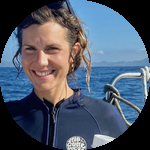
Stephanie Suciu
Stephanie’s work in the Azores embraces participatory science and the development of non-invasive methodologies, particularly for studying sperm whale ecology. Since 2019, she has focused on exploring ocean biodiversity using molecular tools, investigating deep-ocean cephalopod biodiversity and cetacean population genetics through the collection and analysis of sperm whale fecal and sloughed skin samples. These research topics are part of the PhD she is currently finishing.
Stephanie holds a degree in bio-engineering, where she began her research journey studying the physiology of elephant seals. Her international experience has shaped her approach to developing and leading initiatives that integrate science, data management, and communication to achieve impact across diverse audiences. Her strength lies in cross-functional project coordination. Some of her passion are freediving and sailing.
She is the leader of MONICEPH, a collaborative network of whale watching companies that allow bio-samples collection. Her work is featured on France TV "Nous les Européens" serie.
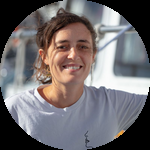
Virginie Wyss
Virginie is a Swiss-born marine biologist with over 14 years of experience in the field of marine biology. Since 2017, she has worked as a Marine Mammal Observer (MMO) and Passive Acoustic Monitoring (PAM) operator, participating in more than 40 scientific and industrial projects worldwide. In 2021, she co-founded a scientific expedition called Glacialis, sailing from the Azores to Greenland aboard a sailboat. This expedition aimed to develop open and participatory science while collecting data on cetaceans and marine ecosystems in still little-studied areas. This human and scientific adventure gave rise to the film Latitude du changement, broadcast on TV5 Monde.
Today, through this new expedition, Virginie wishes to continue this commitment by contributing to the collection of scientific data in regions that remain poorly explored in terms of fauna. The project notably relies on environmental DNA sampling, an innovative and non-invasive method allowing the identification of marine biodiversity from simple seawater samples. By supporting this expedition, you directly contribute to advancing ocean knowledge, promoting collaborative science, and improving our understanding of marine ecosystems—an essential step towards their protection.
Lab Notes
Nothing posted yet.
Project Backers
- 0Backers
- 0%Funded
- $0Total Donations
- $0Average Donation