About This Project
The Herbarium at California Botanic Garden aims to curate and digitize the collections of Russell S. Woglum (1882–1968), an entomologist who collected plants throughout California during the early–mid 1900’s. Collection access will permit researchers to study historical shifts in plant distributions and phenology across California. We hypothesize that these specimens will fill key gaps in California’s botanical record, improving our understanding of regional biodiversity.
Ask the Scientists
Join The DiscussionWhat is the context of this research?
Collections of historic significance offer a lens into the past and a means to envision the future. These functions are especially important as we assess how biodiversity will change with shifts in climate and land use. CalBG Herbarium staff aim to process 722 specimens collected by Russell Sage Woglum (1882–1968), a noteworthy citrus entomologist who made significant contributions to improving pest control in CA’s citrus orchards. Woglum was deeply interested in botany and collected plants extensively in California (1903–1958), representing an invaluable record of the flora during the early–mid 1900’s. This collection has experienced varying degrees of deterioration owing to specimens pressed in original, non-acid-free newsprint. Curation and digitization will facilitate research into historical plant distributions, phenological changes, or biodiversity patterns in California over the past century, and importantly, will ensure preservation so critically needed.
What is the significance of this project?
As herbaria serve expanding needs for research, education, and conservation, it is critical that collections of historic significance are curated and digitized, ensuring their availability for research and, importantly, for long-term preservation. All data will be shared with the Consortium of California Herbaria, with immediate application to a suite of research interests, including systematics, biogeography, phenology, plant conservation, and ecology. This project will support one undergraduate student who will participate in all aspects of curation and digitization. As part of their internship, the student will learn through three workshops: (1) best practices in curation and digitization; (2) collections management; and (3) California diversity, species distributions, and climate change. Through hands-on experiential learning, the student will acquire new skills and will be exposed to career possibilities in the plant sciences and natural history collections.
What are the goals of the project?
We propose to curate and digitize 722 specimens of historic, taxonomic, and geographic significance made by Russell Sage Woglum. The proposed project has five main goals: (1) ensure stabilization and preservation of historically and scientifically valuable collections so critically needed; (2) broaden the Herbarium’s taxic and geographic diversity; (3) provide accessibility of the specimens to researchers, students, and the public; (4) share data with the Consortium of California Herbaria (CCH2; https://cch2.org/portal/) and biodiversity aggregators (iDigBio, https://www.idigbio.org/; GBIF, https://www.gbif.org/); and (5) provide education, training, and capacity building for one undergraduate intern with ambitions of becoming a natural history collections professional.
Budget
Funds are requested to support the purchase of herbarium paper to mount the 722 specimens in this project. No funds are requested for herbarium curatorial staff who will train, mentor, and provide oversight to the intern throughout the project.
Transcription. Collection information will be transcribed to create labels.
Labels. Collection labels will be printed, sorted, and matched to specimens.
Mounting. Specimens will be mounted onto herbarium paper, using archival glue and fragment packets.
Barcode/image. A barcode will be applied to specimens prior to imaging.
Georeference. Georeferencing (assigning latitude and longitude coordinates to collection localities) will increase the research value of the specimens.
Essential to the project's success is the standard herbarium paper to curate the 722 specimens in the collection.
Endorsed by

 Project Timeline
We anticipate that this project will take a total of 200 hours to complete, equivalent to one student intern working part-time, 20 hours a week for 10 weeks. Nazaire and the herbarium curatorial team will interview and hire one student intern, With the expectation that the intern will begin their internship February 2, 2026 and will be completed by April 10, 2026. Milestones for completing outlined in the budget justification are detailed in the next section.
Nov 12, 2025
Project Launched
Dec 10, 2025
Project Launched
Jan 16, 2026
Interview team interviews intern candidates
Feb 02, 2026
Intern start date
Feb 18, 2026
Data entry
Meet the Team
Team Bio
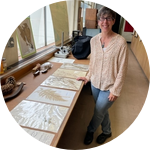
Collectively, the CalBG Herbarium staff have more than 30 years of experience working in herbarium curation and digitization, and have experience in processing specimens of historic significance. Notably, all curatorial staff have competent experience in training and mentoring volunteers and students in best practices of collections management.
Mare Nazaire
Mare Nazaire is the Curator of the CalBG Herbarium and Assistant Professor at Claremont Graduate University. She received her Ph.D. in botany from Washington State University in 2013. Mare has over 20 years of experience in research and leadership positions in herbaria. Her research focuses on the systematics and biogeography of Mertensia (Boraginaceae), floristics of California, and aquatic vascular plants. She is a Taxon Editor for the Flora of North America (FNA) and has authored several treatments for FNA.
Annica Wu is the Collections Manager of the CalBGHerbarium. She received her BS in Plant Science with concentration in Horticulture from California Polytechnic State University, San Luis Obispo. She has supported plant conservation and collections at Huntington Botanical Gardens, Morton Arboretum, andHoover Herbarium at Cal Poly.
Marissa Falla is a Curatorial Assistant at the CalBGHerbarium and is pursuing a B.S. in Plant Science at California State Polytechnic University, Pomona. She holds an A.S. in Horticulture with a focus on Integrated Pest Management. She has contributed to herbarium operations including digitization, specimen imaging, databasing, and field collections. Her work supports ongoing efforts in plant conservation and the curation of botanical archives. She is interested in the preservation and documentation of California's native flora.
Carla Corea is a Curatorial Assistant at the CalBG Herbarium. She received her BS in Plant Science at Cal Poly Pomona. She interned with CalBG, where she was introduced to mounting at the Herbarium, and since has been learning specimen handling and processing, and digitization. This opportunity is in line with her ongoing career in plant conservation.
Deb Woo is a volunteer with CalBG, and has volunteered in the herbarium for >5 years. She brings her experience in data management and Microsoft applications to her role - helping to transcribe collections data and prepare specimen labels.
Lab Notes
Nothing posted yet.
Additional Information
As global shifts in climate and land use are predicted to have severe consequences for biodiversity, timely preservation of these irreplaceable collections will be instrumental to providing baseline data on species diversity in California and for predicting potential implications of climate and land use changes in this biodiversity hotspot.
Integral to the project are the activities involving student participation. CalBG is committed to botanical education and expanding capacity to prepare, train, and educate the next generation of plant scientists and natural history collections professionals. This project will provide training and mentorship for one undergraduate student from one of the academic institutions in the Greater Los Angeles metropolitan area. As part of the student’s internship, herbarium curatorial staff will provide three workshops as they relate to the project: (1) best practices in curation and digitization; (2) collections management; and (3) California diversity, species distributions, and climate change. Through hands-on experiential learning, the student intern will acquire new skills applicable to a broad range of professions and importantly, will be exposed to career possibilities in the plant sciences and natural history collections.
Project Backers
- 1Backers
- 100%Funded
- $500Total Donations
- $500.00Average Donation