

Please wait...
About This Project
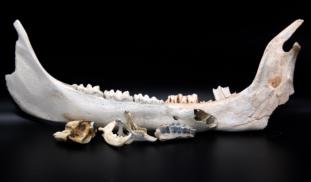
While doing chemical analysis of tooth enamel to reconstruct ancient environments, paleontologists have become over-reliant on the mammalian third molar (M3 or wisdom tooth). The problem with this is that the third-molar is rarely found in younger mammals' jaws, whereas young animals constitute much of the fossil record. Here, we seek to test the viability of using incisors (which are much more common) instead of the M3 as a new, more abundant resource to reconstruct the Earth's past.

Browse Other Projects on Experiment
Related Projects
Reconstructing Historical Oyster Filtration in the Guana River Marsh Aquatic Preserve
The Guana River Estuary in northeast Florida is impaired due to excess nutrients, which can fuel eutrophic...
How do California redwood stomata change with height? What are the implications in physiology and taxonomy?
California’s two redwood species presently stand as Earth’s tallest, largest, most carbon-sequestering...
Can we use phytoliths in modern savanna soil to understand past ecosystems?
Phytoliths are microscopic silica particles produced by plants that can be easily fossilized and preserved...
